
|
Eagle Trace
serving our neighbors strengthens our community
|
Boulevard Ash Trees
"Tree Killing" Fungus - December 2025
Eagle Trace has a new threat to our beautiful, boulevard ash trees. We've had several arborists identify the white growth along the trunk as a “wood-rotting fungus”, but they were unable to identify the specific type of fungus or provide accredited information. The HOA Board decided to consult Purdue’s Plant and Pest Diagnostic Laboratory.
After submitting a sample of the fungus, Purdue was able to provide the following information:
- The fruiting body sample did not have enough clear characters to ID by morphology.
- The DNA sequence analysis confirms this fungus is from the Fomitopsis genus.
- The species of Fomitopsis fungi was not clear from the testing. It is unidentifiable.
- Several species of Fomitopsis cause brown rot, however this one produces white rot.
- The only prior report in scientific record where Fomitopsis causes white rot on ash trees is from Minnesota in 1976, which means occurrences of this species are extremely rare.
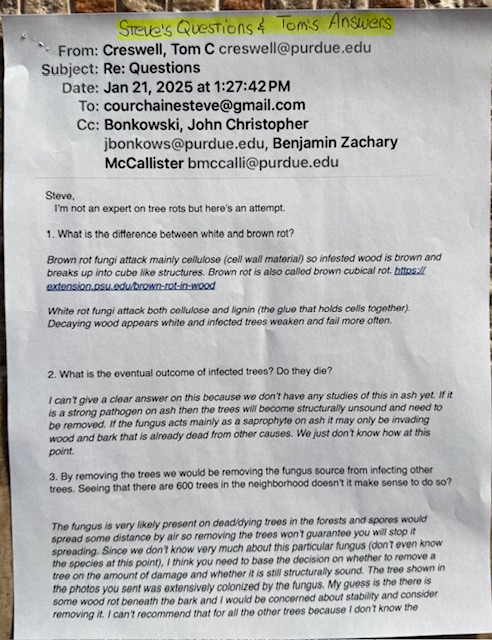
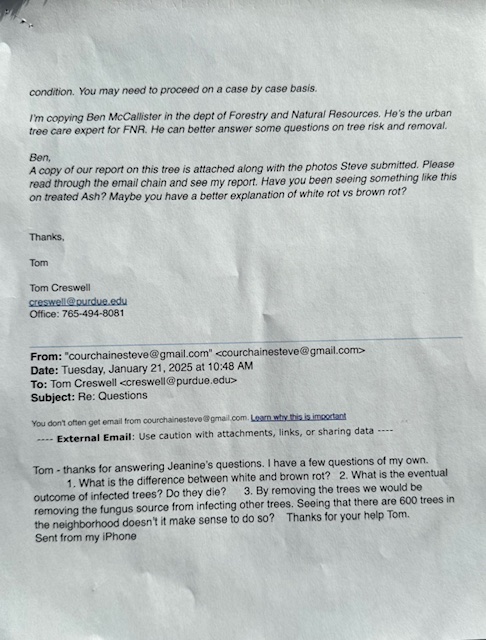
The HOA Board asked follow-up questions to ensure they are guiding Eagle Trace residents correctly. Below is a synopsis of Purdue's responses.
- White rot fungi attack both cellulose and lignin, which is the glue that holds cells together. Decaying wood appears white and the infected tree will weaken over time.
- Because there are no studies on this fungus, they can only guess that infected trees will experience wood rot beneath the white bark. If this is happening, the tree will become structurally unsound over time because of the softened and weakened state of the wood.
- Because the fungus is likely present on dead/dying trees in the surrounding forest and spores spread some distance by air, removing the infected trees won’t guarantee the spreading will stop.
- We should remove trees based on the amount of damage done by the fungus, meaning if the tree has become structurally unsound, the tree should be removed.
As part of the Eagle Trace community, please do your part by:
1 - REMOVING THE DISEASED TREES BY END OF WINTER 2025-2026.
We are asking those with diseased trees to have them removed this winter when the trees are dormant and the spores are less active. This will decrease the number of new cases in spring and summer of 2026.
- List of addresses with fungus infected trees as of September 2025
- Map of the diseased trees in Eagle Trace
Residents removing trees can use whatever company they would like to remove the infected trees, though we have arranged a very good group rate with Angel Oak Tree Care (317) 525-1145.
- $750 for trees in Sections 1-3
- $500 in Section 4
- This includes grinding of the stump.
2 - MAKE THE HOA BOARD AWARE.
- Please make the HOA aware that you have made arrangements to remove your infected trees via our website Contact Us.
- The HOA will partner with our residents to plant replacement trees (not ash) using the Tree Replacement Fund in the 2026 Budget.
Emerald Ash Borer (EAB) Treatment
Residents of Eagle Trace enjoy tree-lined streets, and we take pride in caring for our 600+ boulevard ash trees. The original vision of canopying branches over our avenues has been almost completely achieved, as the first trees are now 25 years old. They provide both shade and beauty to our neighborhood. Since the invasion of the non-native Emerald Ash Borer, the trees are at risk. EAB is fatal if untreated. We have taken a pro-active approach since 2007 to protect them, always using the most current research. A professional EAB treatment is applied every three years for all boulevard ash trees and is included annually in your homeowner's dues.
Pages
- Home
- Calendar
- Neighborhood Directory
- Pet Directory
- Contact Us
- Neighborhood Manager
- Home Improvements
- Neighborhood Info
- News
- Boulevard Ash Trees
- Helpful Contacts
- FAQs
- Communication
- Resident Forum
- Alert Your Neighbors
- Classifieds
- Newsletters
- Board Meeting Info
- Annual Meeting Minutes
- Meeting Minutes
- Board Members
- Documents
- Declaration of Covenants
- Covenants Amendment 2020
- Map of Eagle Trace
- 2025 Proposed Budget
- Purdue - Lab Report On Fungus
- Purdue - Email about Fungus pt. 1
- Purdue - Email about Fungus pt. 2
- 2026 Budget & 2025 Expenses
- Boulevard Trees w/ Fungus 2024-2025
- Diseased Tree Map
- ACC Submissions